


Pickleball Wrist Fractures: Rising Injuries in Florida
[lwptoc]
Key Takeaways
- Pickleball wrist fractures increased by 200% in Florida since 2020
- Most injuries happen during backward movements and falls
- Early treatment prevents long-term problems
- Florida Sports Injury offers specialized care for pickleball players
- Prevention through proper technique reduces injury risk by 60%
Pickleball wrist fractures are now one of the fastest-growing injuries in Florida. Emergency rooms report a 200% increase since 2020. This matches the sport’s explosive popularity. What started as a retirement activity has become competitive athletics for all ages.
Additionally, Florida’s year-round playing season means players never get natural recovery time. Therefore, sports medicine specialists see more injuries than ever before.
Understanding Pickleball Wrist Fractures
Pickleball creates unique injury patterns. Players make rapid direction changes and backward movements. Furthermore, overhead shots can compromise balance. When falls occur, players instinctively catch themselves with an outstretched hand. Consequently, force transfers directly to the wrist bones.
Moreover, Florida’s conditions create more risk. Humidity wears down court surfaces faster. Many community courts have outdoor surfaces that become slippery after rain. Therefore, fall risk increases significantly.
According to the National Library of Medicine, wrist fractures in racquet sports have increased among adults over 50. Additionally, pickleball represents the fastest-growing category. The American Academy of Orthopaedic Surgeons reports that sports-related wrist injuries now account for 15% of all fractures.
 Common Pickleball Wrist Fracture Types
Three main types of pickleball wrist fractures occur most often:
Distal Radius Fractures from Pickleball
This is the most common pattern. It happens when players fall backward during net exchanges. The distal radius breaks at its end where it meets the hand. Furthermore, this fracture can involve the joint surface. Therefore, it may require surgery to prevent arthritis later.
Scaphoid Fractures in Pickleball Players
The scaphoid bone sits at the thumb base. It breaks during falls onto an outstretched hand. Moreover, these injuries are particularly concerning. The bone has poor blood supply. Consequently, it can fail to heal if not treated properly. The Centers for Disease Control and Prevention identifies scaphoid fractures as a leading cause of chronic wrist pain in athletes.
Ulnar Styloid Fractures
These injuries affect the bony bump on the pinky side of the wrist. They are less common but equally problematic. Additionally, they often occur with distal radius fractures. Therefore, they can compromise wrist stability if not addressed.
Quick Answers: What You Need to Know
- Immediate response: Stop playing immediately. Apply ice and seek medical help within 24 hours.
- Diagnosis timeline: X-rays provide quick answers. However, MRI or CT may be needed for complex fractures.
- Treatment options: Casting works for simple breaks (4-6 weeks). Surgery fixes complex fractures with plates and screws.
- Recovery time: Simple fractures heal in 6-8 weeks. Complex injuries may need 3-6 months.
- Return to play: Gradual progression under medical guidance prevents re-injury.
Why Florida Players Get Pickleball Wrist Fractures
Florida’s unique factors increase the risk of pickleball wrist fractures. The state leads the nation in both pickleball participation and related injuries.
Age and Bone Density
Florida’s large retirement population means many players are over 60. This age group faces the highest risk for pickleball wrist fractures due to decreased bone density. Furthermore, postmenopausal women face a particularly high risk. The National Institutes of Health reports that osteoporosis affects nearly 25% of Florida women over 65.
Court Conditions
Humidity accelerates court wear in Florida. This creates uneven playing surfaces. Additionally, outdoor courts become slippery during morning dew. Therefore, fall risk increases significantly. Indoor courts offer temperature control. However, they often have hard surfaces that provide no cushioning during falls.
Playing Intensity
Florida’s competitive pickleball community drives players to push limits. Tournament play creates scenarios where fatigue affects balance. Consequently, reaction time suffers. This creates prime conditions for pickleball wrist fractures.
How We Diagnose Pickleball Wrist Fractures
Dr. Amit Varma and our team at Florida Sports Injury & Orthopedic Institute use a thorough approach. First, we take a detailed injury history. Understanding how the fall happened helps predict fracture patterns. Additionally, it reveals associated soft tissue damage.
Our physical examination includes:
- Checking bony landmarks for tenderness
- Testing range of motion
- Checking nerves and blood vessels
- Measuring grip strength
Next, imaging studies follow a clear path:
Standard X-rays
Three views capture most wrist fractures. Dr. Varma personally reviews these. Therefore, we identify subtle fractures that emergency rooms might miss.
CT Scanning
Complex fractures need CT evaluation. This three-dimensional imaging guides surgical planning. Furthermore, it clearly shows fragment displacement. The American College of Radiology recommends CT for all joint surface fractures.
MRI Studies
Sometimes X-rays appear normal, yet symptoms persist. In these cases, MRI can find hidden fractures. Additionally, it shows ligament tears or cartilage damage. Scaphoid fractures particularly benefit from early MRI. Therefore, we catch them before complications develop.
Treatment Options for Pickleball Wrist Fractures
| Feature | Florida Sports Injury Institute | General Clinics | Emergency Rooms |
|---|---|---|---|
| Sports Medicine Training | Fellowship-trained in sports injuries | General training only | Limited sports knowledge |
| Same-Day Visits | Available for acute injuries | Wait times 3-7 days | Immediate but not specialized |
| Advanced Imaging | On-site X-ray, MRI, ultrasound | May need outside referrals | X-ray only |
| Surgery Options | Minimally invasive techniques | Traditional open surgery | Referral to outside surgeon |
| Rehab Services | In-house therapy for pickleball | Generic protocols | No rehab services |
| Return-to-Play | Sport-specific progression | Basic clearance | No follow-up |
| Insurance | Most major plans accepted | Varies | Often higher costs |
| Patient Portal | 24/7 access to records | Limited online services | No ongoing access |
At Florida Sports Injury & Orthopedic Institute, Dr. Varma’s double board certification ensures comprehensive care. His training in both orthopedic surgery and sports medicine addresses immediate injury and long-term athletic goals. Furthermore, our experience with pickleball athletes means treatment plans match the sport’s specific demands.
Non-surgical treatment includes:
- Custom splinting with weekly monitoring
- Early movement protocols to prevent stiffness
- Bone stimulation therapy for faster healing
- Nutrition counseling for bone health
However, surgery becomes necessary when:
- Fracture moves more than 2mm
- The joint surface is damaged
- Ligament injuries accompany the fracture
- Bone fails to heal despite treatment
Dr. Varma uses minimally invasive techniques whenever possible. These include:
- Percutaneous pinning for stable fractures
- Volar plate fixation for radius fractures
- Arthroscopic reduction for joint injuries
- Headless screw fixation for scaphoid fractures
Recovery from Pickleball Wrist Fractures
Successful recovery requires a structured approach. The timeline varies based on fracture severity and treatment method. However, following the plan closely improves outcomes.
Weeks 1-2: Acute Phase
First, we focus on pain control and swelling reduction. Patients keep the wrist elevated. Additionally, ice therapy helps. Dr. Varma schedules follow-ups to monitor healing with repeat X-rays.
Weeks 3-6: Healing Phase
Bone healing progresses during this time. Early movement exercises begin. Dr. Aalok Shah, our nonoperative sports medicine physician, works with patients who are progressing well without surgery. Furthermore, physical therapy introduces gentle movement. This prevents joint stiffness while protecting healing bone.
Weeks 7-12: Strengthening Phase
Most simple pickleball wrist fractures have healed enough to begin loading. Grip strengthening starts. Additionally, wrist curls and functional exercises prepare patients for activities. For pickleball players, this phase includes sport-specific drills. These mimic game movements without complete contact.
Months 3-6: Return to Sport
Gradual return to pickleball begins with doubles play. Next, it progresses to singles. Finally, competitive matches resume. Dr. Varma clears patients based on:
- Complete fracture healing on X-ray
- Full pain-free movement
- Grip strength at 80% of the uninjured side
- Successful sport-specific testing
Preventing Pickleball Wrist Fractures
Prevention requires addressing equipment, technique, and conditioning. These strategies can reduce injury risk by 60%. Research from the American Orthopaedic Society for Sports Medicine supports this.
Equipment Changes
- Use paddles with a
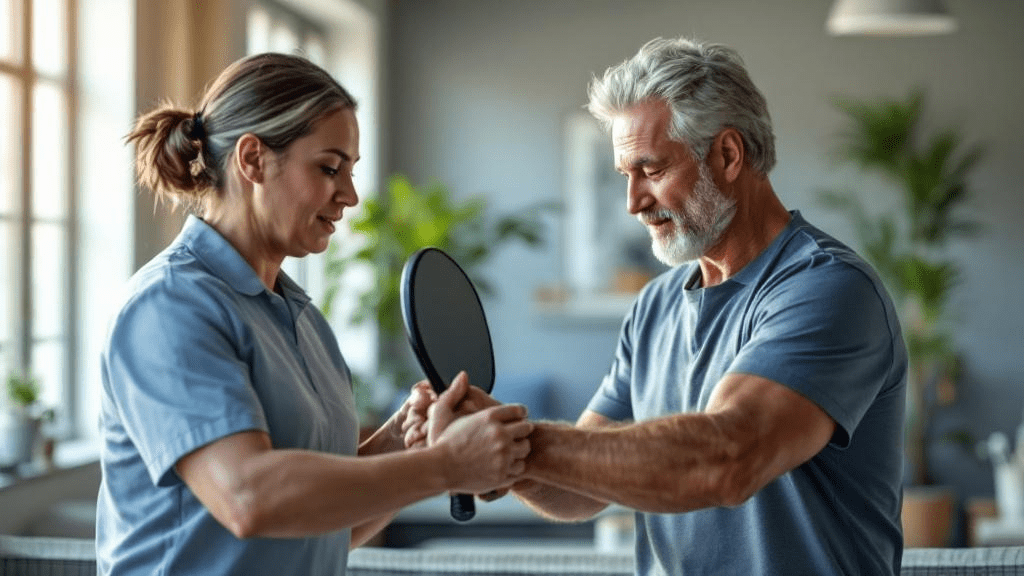 proper grip size to reduce wrist strain
 - Wear court shoes with good lateral support
- Consider wrist guards during high-intensity play
- Replace worn shoes every 3-4 months
Technique Improvements
- Work with a certified instructor to refine footwork
- Practice controlled backward movements
- Strengthen core for better balance
- Learn proper falling techniques that protect wrists
Physical Conditioning
- Maintain bone health through weight-bearing exercise
- Take vitamin D and calcium as your doctor recommends
- Include balance training in weekly workouts
- Strengthen wrist muscles with specific exercises
Dr. Brian Patterson, our sports medicine physician, offers prevention consultations for pickleball players. These sessions include video analysis of your technique. Additionally, you receive customized exercise programs.
Serving Central Florida
Florida Sports Injury & Orthopedic Institute
1925 Don Wickham Drive
Clermont, FL 34711
(352) 404-8956
We serve Clermont, Winter Garden, Windermere, Ocoee, Apopka, Mount Dora, Leesburg, and surrounding Lake County communities. We’re the trusted partner for treating pickleball wrist fractures throughout Central Florida.
When to Get Help for Pickleball Wrist Fractures
Get immediate help at Varma Shoulder Institute or Florida Sports Injury & Orthopedic Institute if you have:
- Severe wrist pain after a fall during play
- Visible wrist or hand deformity
- Inability to move fingers or wrist
- Numbness or tingling in fingers
- Swelling that develops quickly after injury
Don’t wait for symptoms to worsen. Early diagnosis by fellowship-trained specialists ensures the best outcomes. Dr. William Athans (Sports Medicine) and Dr. Peter Shekailo (Adult Reconstructive Surgery) provide expert care. For hand and wrist concerns, Dr. Matthew Lee Welsh, a fellowship-trained Hand Surgeon, offers specialized treatment.
Call or text (352) 404-8956 for same-day appointments. Our walk-in clinic means you don’t need to wait in pain. Furthermore, we offer convenient scheduling options.
Common Questions About Pickleball Wrist Fractures
How long before I can play pickleball again after a wrist fracture?
Most players return to doubles play at 8-12 weeks. Additionally, competitive singles typically resume at 12-16 weeks. However, Dr. Varma provides timelines based on your specific healing. Furthermore, we monitor your progress closely throughout recovery.
Will I need surgery for my pickleball wrist fracture?
About 60% of pickleball wrist fractures heal with casting alone. However, surgery becomes necessary when fractures are displaced. Additionally, surgery helps when the joint surface is involved. Furthermore, our team uses minimally invasive techniques to speed recovery.
Can I prevent pickleball wrist fractures?
Yes, you can significantly reduce risk. Proper conditioning helps prevent injuries. Additionally, technique changes lower your chances. Furthermore, appropriate equipment makes a big difference. Our doctors offer prevention consultations specifically for pickleball players.
What’s the difference between a wrist sprain and a pickleball wrist fracture?
Both cause pain and swelling. However, fractures prevent weight-bearing through the hand. Furthermore, fractures cause severe pain with any movement. X-rays show the difference clearly. Therefore, getting proper imaging is essential for correct diagnosis.
Does insurance cover treatment for a pickleball wrist fracture?
Most insurance plans cover treatment for pickleball wrist fractures. Florida Sports Injury accepts most major insurance plans. Additionally, we offer flexible payment options. Our staff helps you understand your coverage before treatment begins.
Ready to Get Back on the Court?
Don’t let pickleball wrist fractures sideline your game. Florida Sports Injury & Orthopedic Institute provides comprehensive care from diagnosis through return-to-play. Our fellowship-trained specialists understand pickleball’s unique demands. Furthermore, we create treatment plans that get you back to the sport you love.
Download our FREE Pickleball Injury Prevention Guide — includes warm-up routines, strengthening exercises, and technique tips from our sports medicine team.
1925 Don Wickham Drive, Clermont, FL 34711
Same-day appointments available. The walk-in clinic is open. Durable medical equipment on-site.














Most Commented